 SchedPilot
How Much Does YouTube Pay for 1000 Views? Real 2026 Numbers by Niche
Short answer: YouTube pays most creators between $2 and $10 per 1,000 views in 2026, with $3–$5 being the global median. But that range hides a 30x gap — a finance channel can earn $29 per 1,000 views while a gaming channel earns under $1.50 for the exact same view count.
This guide breaks down the real numbers by niche, explains why the range is so wide, walks through the formula YouTube actually uses to pay you, and shows what creators can do to move from the low end to the high end.

Quick navigation:
- Does YouTube pay per view? (Not exactly)
- CPM vs RPM — the two numbers that matter
- YouTube pay by niche in 2026
- How much does YouTube Shorts pay?
- What affects your earnings
- YouTube earnings calculator (try the formula)
- When does YouTube start paying you?
- Real earnings scenarios
- YouTube vs TikTok vs Facebook Reels pay
- How to earn more per 1,000 views
- FAQ
Try SchedPilot for free
Free trial · No upfront payment · 10+ platforms
Post on 10 platforms at once. Great for influencers, marketers, agencies.
Does YouTube pay per view? (Not exactly)
Here’s the thing most explainers get wrong in the first sentence: YouTube doesn’t pay you for views. YouTube pays you a share of the ad revenue generated on those views.
The distinction matters. If 1,000 people watch your video but 400 are using ad blockers and 200 have YouTube Premium, you’re only monetizing 400 views through ads. The Premium watchers still pay you — just through a different bucket — but the practical math is that not every view earns the same.
Here’s the actual flow:
- An advertiser pays YouTube to show an ad. YouTube charges them based on CPM — cost per thousand ad impressions.
- The ad plays on your video.
- YouTube keeps 45% of that ad revenue.
- You get 55%.
So if an advertiser pays $10 to show their ad to 1,000 viewers on your video, YouTube keeps $4.50 and you get $5.50. That’s the basic model — but it gets more complicated because not every one of your video views triggers an ad.
CPM vs RPM — the two numbers that matter
These two acronyms confuse almost every new creator. They measure different things, and knowing the difference stops you from over-estimating your earnings.
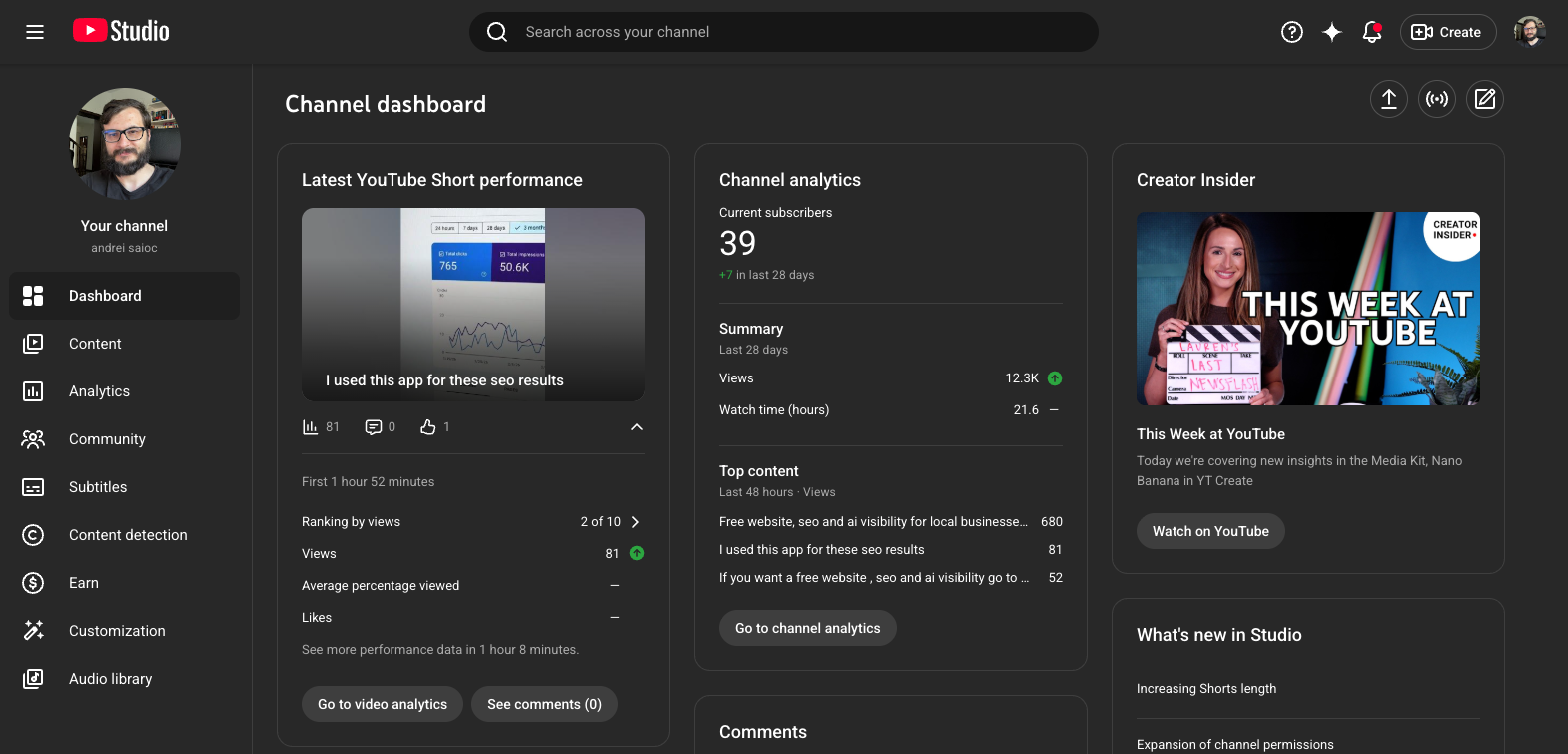
CPM (Cost Per Mille) is what advertisers pay per 1,000 ad impressions, before YouTube takes its cut. You’ll see this in YouTube Studio. A high CPM looks exciting, but it’s not what you earn.
RPM (Revenue Per Mille) is what you earn per 1,000 video views, after YouTube’s cut and after accounting for views that didn’t show ads. This is the number that actually matters for your bank account.
The gap between the two is usually huge. A video with a $20 CPM typically produces around $4–$8 RPM. Why? Because YouTube takes 45%, and maybe only 50–60% of your video views actually showed an ad in the first place.
| Metric | What it measures | Who it applies to | Example |
|---|---|---|---|
| CPM | Cost per 1,000 ad impressions | Advertisers | $20 |
| RPM | Revenue per 1,000 video views | Creators (you) | $4–$8 |
Bottom line: when someone tells you “my CPM is $15,” don’t assume they’re making $15 per 1,000 views. Their actual RPM is probably $4–$7. Always ask for RPM if you want a real answer.
YouTube pay by niche in 2026
Niche is the single biggest factor in what you earn. Advertisers pay wildly different rates depending on how valuable your audience is to them. Someone watching a personal finance video might be ready to open a $5,000 brokerage account. Someone watching gaming content is much less likely to make a high-value purchase. Advertisers know this, and they price accordingly.
Here’s what creators are actually earning in 2026 based on industry data and creator-reported RPMs:
| Niche | Typical RPM (per 1,000 views) | Notes |
|---|---|---|
| Personal Finance / Investing | $12–$29 | Credit cards, investing, mortgages pay highest |
| Make Money Online / Business | $10–$20 | High-intent audience, expensive keywords |
| Digital Marketing / B2B SaaS | $8–$15 | Advertisers target working professionals |
| Real Estate | $8–$14 | High-ticket advertisers |
| Technology / Software Reviews | $5–$12 | Varies with brand sponsorship potential |
| Health / Fitness | $4–$9 | Supplements and programs pay well |
| Education / How-to | $4–$8 | Steady, not spectacular |
| Food / Cooking | $2–$6 | Broad audience, moderate CPMs |
| Lifestyle / Vlogs | $2–$5 | Wide demographic dilutes CPM |
| Beauty / Fashion | $2–$5 | Strong for sponsorships, weaker for AdSense |
| Gaming | $1–$3 | Low CPM, but Shorts and memberships help |
| Comedy / Entertainment | $1–$3 | Advertisers see lower conversion intent |
| Music / Reaction | $0.50–$2 | Copyright claims also hurt here |
| YouTube Shorts (any niche) | $0.04–$0.10 | Separate revenue pool, always low |
The takeaway: a finance video and a gaming video can have identical view counts and one earns 15× more than the other. If you’re choosing between two content directions and both feel equally fun to make, the RPM difference is worth factoring in.
Real creator examples
- Josh Mayo, personal finance, has publicly reported $29.30 RPM focused on credit card and investing content.
- Business Insider’s creator survey found entertainment channels earning as low as $1.61 per 1,000 views.
- Mid-tier tech reviewers consistently report $6–$9 RPM with U.S.-heavy audiences.
How much does YouTube Shorts pay per 1,000 views?
If you’ve spent any time creating Shorts, the numbers here are painful: YouTube Shorts pay $0.04 to $0.10 per 1,000 views on average. That’s roughly 1/50th of what long-form videos earn in the same niche.
Why? Shorts revenue works differently. Instead of ads playing on your specific video, YouTube pools ad revenue from all Shorts ads shown between creators’ videos, then distributes it proportionally based on views. YouTube keeps more of that pool than it does for long-form ads.
A concrete example: one creator recently reported 7 million Shorts views earned $383 total — about $0.055 per 1,000 views. The same creator’s long-form videos were earning $5–$7 per 1,000 views.
So why create Shorts at all? Two reasons:
- Subscriber acquisition. Shorts are still the fastest way to discover new viewers on YouTube. Many successful channels use Shorts as a top-of-funnel tool, driving Shorts viewers to subscribe and eventually watch long-form videos.
- Cross-platform reuse. A 9:16 vertical clip you create for Shorts also works as an Instagram Reel, TikTok video, LinkedIn native video, and Pinterest Idea Pin. The Shorts revenue itself is small, but the same asset can multiply across platforms.
The creators earning the most from Shorts aren’t the ones chasing Shorts revenue — they’re the ones using Shorts as a feeder system for their long-form content (and scheduling the same clip across every platform to maximize compounding reach).
What actually affects your earnings per 1,000 views
Niche is the biggest factor, but it’s not the only one. Five variables explain almost all of the variance in creator RPMs:
1. Audience geography
U.S., Canada, UK, and Australia audiences produce the highest CPMs — often $20–$35 at the advertiser level. Audiences in emerging markets produce dramatically lower rates, sometimes under $1 CPM. You can’t control where your viewers live, but you can create content that naturally resonates with high-CPM regions (English-language, topics relevant to Western consumer markets, posting at times that align with U.S. evening viewing).
2. Video length
Videos under 8 minutes can only show pre-roll and post-roll ads. Videos over 8 minutes unlock mid-roll ads — you can place 2–3 additional ad breaks throughout the video. A 12-minute video with well-placed mid-rolls often earns 2x what a 6-minute version of the same content earns.
3. Watch time / audience retention
The longer a viewer watches, the more ads they see. A 30-second drop-off means one pre-roll ad. A full 15-minute watch through means 3–4 ad impressions. YouTube’s algorithm also rewards retention with more recommendations, creating a compounding effect.
4. Seasonality
Q4 (October–December) consistently pays the most as advertisers flood the system with holiday budgets. January and February are the worst months — CPMs can drop 30–40% compared to Q4. Your views might stay steady while your revenue halves. This isn’t something you did wrong; it’s the ad market.
5. Ad-friendliness
YouTube limits monetization on videos that touch controversial topics, profanity, violence, or anything outside their advertiser-friendly content guidelines. A video with the “yellow dollar sign” (limited monetization) might earn 90% less than the same video without it. Self-censoring isn’t always worth it creatively, but know the trade-off.
YouTube earnings calculator (try the formula)
You don’t need a fancy tool — the math is simple. Here’s the formula:
Estimated earnings = (Views × Monetized %) × (CPM ÷ 1000) × 0.55
Where:
- Views = total video views
- Monetized % = the share of views that actually showed an ad (typically 40–60%)
- CPM = what advertisers pay per 1,000 ad impressions (varies by niche)
- 0.55 = your 55% share after YouTube’s cut
Example 1: Tech review channel, 100,000 views
- Monetized rate: 55%
- CPM: $10
- Earnings: 100,000 × 0.55 × ($10 ÷ 1000) × 0.55 = $302.50
- That’s an RPM of about $3.03
Example 2: Finance channel, 100,000 views
- Monetized rate: 55%
- CPM: $25
- Earnings: 100,000 × 0.55 × ($25 ÷ 1000) × 0.55 = $756.25
- That’s an RPM of about $7.56
Even in the finance example — which is one of the highest-paying niches — the real RPM is $7.56, not $25. The gap between CPM and what you actually pocket is what makes most YouTube earnings predictions wildly optimistic.

When does YouTube start paying you?
Before you can earn anything from ads, you need to join the YouTube Partner Program (YPP). The current requirements as of 2026:
For full ad monetization:
- 1,000 subscribers
- 4,000 valid public watch hours in the past 12 months
- OR 10 million valid public Shorts views in the past 90 days
For early monetization features (Super Thanks, channel memberships, Super Chat):
- 500 subscribers
- 3,000 watch hours in the past 12 months or 3 million Shorts views in 90 days
- 3 public uploads in the last 90 days
Once you’re accepted into YPP, AdSense starts paying you once you cross $100 in earnings — and payments happen around the 21st of the month following the month you crossed that threshold.
Realistic timeline for new creators: most creators take 6–18 months to hit YPP eligibility if they’re posting consistently (1–2 videos per week). Shorts-focused creators can sometimes hit the 10M views threshold faster, but they’ll earn less per view afterward.
Real earnings scenarios: what YouTube actually pays you monthly
Theoretical RPMs are one thing. Here’s what creators actually bring home at different scales and niches:
| Channel Profile | Monthly Views | RPM | Monthly AdSense |
|---|---|---|---|
| New creator, general lifestyle | 10,000 | $3 | $30 |
| Tech reviewer, U.S.-focused | 100,000 | $7 | $700 |
| Finance creator, credit cards | 50,000 | $15 | $750 |
| Food/cooking, mid-size | 250,000 | $4 | $1,000 |
| Established tech channel | 500,000 | $6 | $3,000 |
| Gaming creator, high volume | 1,000,000 | $2 | $2,000 |
| Personal finance, established | 500,000 | $18 | $9,000 |
| Shorts-only creator | 5,000,000 | $0.06 | $300 |
Notice two things. First, the Shorts-only creator with 5 million monthly views earns less than the new lifestyle creator with 10,000 long-form views. Second, a 50,000-view finance channel out-earns a 250,000-view food channel. Niche and format almost always matter more than raw view count.
One million views is not $10,000. For most creators, 1 million views generates $1,200–$6,000 from AdSense. If you’re hearing higher numbers, they’re either outliers, including sponsorships, or talking about CPM instead of RPM.

YouTube vs TikTok vs Facebook Reels — which pays most per 1,000 views?
If you’re deciding where to focus your video content, here’s how the platforms compare on direct creator payouts in 2026:
| Platform | Per 1,000 Views | Notes |
|---|---|---|
| YouTube long-form | $2–$10 | Best direct creator economy |
| YouTube Shorts | $0.04–$0.10 | Pool-based, always low |
| TikTok Creator Rewards | $0.20–$1.00 | Replaced the old Creator Fund |
| Instagram Reels | $0.01–$0.05 | Bonus programs only, invite-only |
| Facebook Reels | $0.02–$0.10 | Inconsistent, market-dependent |
| LinkedIn video | $0 (no native ad-share) | Revenue via leads, not ads |
| X / Twitter | $0.10–$0.50 | Creator ads revenue share program |
YouTube long-form wins by a wide margin for direct monetization. The practical strategy most top creators use: build on YouTube as your main monetization engine, then use shorter platforms (TikTok, Reels, Shorts) as discovery feeders that funnel attention back to your YouTube channel. This is exactly the playbook that works for both individual creators and agency-managed brand channels.
How to earn more per 1,000 views
If your current RPM is $2 and you want to push it to $5 or $10, here’s what actually moves the needle — ranked by impact.
1. Make videos over 8 minutes (when the content earns the length)
This is the single biggest free RPM boost available to you. Any video over 8 minutes can run 2–3 mid-roll ads in addition to pre- and post-roll. Done well — mid-rolls placed at natural breaks, not mid-sentence — this can double your RPM on the same content. Done poorly, it annoys viewers and hurts retention, which wipes out the gain.
2. Shift your niche angle toward higher-paying topics
You don’t have to abandon your channel identity, but you can steer toward higher-RPM topics within your niche. A tech creator can talk about B2B software (high CPM) instead of consumer gadgets (lower CPM). A lifestyle creator can touch on budgeting and personal finance (high CPM) instead of pure vlogging. Small angle shifts compound over time.
3. Optimize for U.S. and English-speaking audiences
If your audience is global, leaning into topics that resonate with U.S. viewers — and posting when U.S. audiences are online (typically 6–10 PM ET) — will shift your CPM upward. This isn’t about excluding anyone; it’s about reaching the highest-paying audience segments your content can serve.
4. Enable every ad format in monetization settings
In YouTube Studio → Monetization, turn on display ads, overlay ads, skippable video ads, and non-skippable ads (when appropriate for your content). More ad formats mean more fill rate, which means higher RPM. Most creators leave some formats disabled by default and forget to check.
5. Build audience retention, not just views
A 10-minute video with 70% average view duration earns far more than a 10-minute video with 30% retention. Retention is what triggers mid-roll ads actually playing. Hook viewers in the first 15 seconds, deliver value quickly, cut dead space ruthlessly.
6. Grow through cross-posting (without doing more work)
The fastest way to earn more from 1,000 views is to stop earning from only 1,000 views. Every YouTube long-form video can be cut into 3–5 short clips that work natively on TikTok, Instagram Reels, LinkedIn, Pinterest, and X. Each of those clips drives viewers back to your full YouTube video — and each view on YouTube earns you real ad revenue, while the short-form reach is essentially free.
This is where having a scheduler matters. Doing this manually across 5+ platforms eats your entire week. SchedPilot lets you upload a clip once and schedule it to YouTube Shorts, TikTok, Instagram Reels, LinkedIn, Pinterest, and more simultaneously — so cross-posting stops being the reason you don’t do it.
7. Don’t depend on AdSense alone
Most full-time YouTubers earn more from sponsorships, affiliate deals, and their own products than from AdSense. A single sponsor integration on a 100,000-view video might pay $2,000–$5,000 — more than the ad revenue from that same video’s lifetime views. AdSense is the base layer; sponsorships and products are where most creator income actually sits once you cross 50,000+ subscribers.
Try SchedPilot for free
Free trial · No upfront payment · 10+ platforms
Post on 10 platforms at once. Great for influencers, marketers, agencies.
Frequently Asked Questions
Can I just multiply my views by a dollar amount to estimate earnings?
Not accurately. The cleanest estimate is: check your RPM in YouTube Studio Analytics after a month of monetized activity, then multiply your views by that RPM ÷ 1,000. Before you have your own RPM data, assume $2–$5 per 1,000 views for a general channel and $8–$15 for a business/finance niche.
Why did my RPM drop even though my views went up?
Common causes: (1) more views coming from lower-CPM countries, (2) one of your videos hit “limited monetization” due to content guidelines, (3) seasonal drop (January always pays less than December), (4) your newer videos are shorter and don’t run mid-rolls, (5) audience demographic shifted younger.
Does YouTube Premium help or hurt creators?
It helps. Premium subscribers don’t see ads, but YouTube pays creators based on Premium members’ watch time on their videos. The rate varies, but it typically compensates reasonably well — sometimes slightly better than ad-supported views would have.
How much does 1 million YouTube views pay?
Between $1,200 and $6,000 for most channels. Finance and B2B channels can push that to $15,000–$30,000. Pure gaming or entertainment channels might come in at $800–$2,000. The 30× spread is real and driven mostly by niche.
Do channel memberships, Super Thanks, and Super Chat pay better than ads?
The revenue split is better — YouTube keeps 30% on those instead of 45% on ads. But volume is usually far lower. They work well for channels with strong community engagement and less well for channels focused purely on search-driven traffic.
How much does YouTube pay for 10,000 views?
For a general channel at $3–$5 RPM, about $30–$50. For a tech channel at $7 RPM, about $70. For a finance channel at $15 RPM, about $150. For a gaming channel at $1.50 RPM, about $15. For Shorts at $0.06 RPM, about $0.60.
What if my content gets demonetized?
You still earn something from Premium subscribers’ watch time, but ad revenue drops to near zero. Appeal the demonetization in YouTube Studio — about 40% of manual review appeals succeed if your content genuinely doesn’t violate the guidelines. Going forward, avoid the trigger (usually profanity in the first 30 seconds, controversial framing, or copyrighted music).
Does posting more often increase my RPM?
No — posting frequency doesn’t directly affect RPM. But it does grow your total views, which grows total revenue. And consistent uploads train YouTube’s algorithm to recommend your channel more aggressively, which attracts higher-value viewers over time.
Try SchedPilot for free
Free trial · No upfront payment · 10+ platforms
Post on 10 platforms at once. Great for influencers, marketers, agencies.
The bottom line
YouTube pays most creators $2–$10 per 1,000 views, with niche determining almost everything. Finance and business content pays 5–10× more than entertainment content for the same view count. Shorts pay roughly 1/50th of long-form. Your geography, video length, and ad-friendliness all pull the number up or down from there.
The single most leverage-heavy move for creators who want higher per-view earnings isn’t chasing a different niche — it’s doing two things at once: making videos over 8 minutes on topics that attract premium advertisers, and using every short clip to feed viewers back to those long-form videos through cross-posting on every other platform.
If you’re spending 3+ hours a week manually re-uploading clips to Instagram, TikTok, LinkedIn, and Pinterest, SchedPilot handles that in a single upload across 10+ platforms — freeing that time to go into what actually grows your channel: making more and better videos.
Curious what your own channel should be earning? Check your RPM in YouTube Studio → Analytics → Revenue. That single number tells you more than any average on the internet.
Related posts
How Much Money Is 10 Million Views on YouTube? (2026 Earnings Breakdown)
June 1, 2026
How Much Does YouTube Pay for 1 Million Views in India? (2026 Real Numbers)
May 18, 2026
Best YouTube Analytics Tools in 2026: Data-Driven Picks for Serious Creators
May 6, 2026
When Does YouTube Start Paying You? (Complete 2026 Guide)
April 22, 2026