 SchedPilot
How to Grow Instagram Followers Organically in 2026, With a Weekly Calendar You Can Copy
An account with 500 followers that grows 10% a month ends the year at about 1,570. That’s triple, from a rate that feels like nothing while it’s happening: roughly two new followers a day at the start. Most people quit in month two because two followers a day doesn’t look like a strategy working. It is.
Organic growth on Instagram is mostly a consistency problem wearing a creativity costume. The tactics below matter, and some popular ones are a waste of your evening, but the accounts that grow are nearly always the ones that kept publishing for six months without gaps.
So this article spends as much time on the calendar and the workflow as on the tactics, because that’s the part that decides whether you’re still posting in week eleven.
Free trial · No upfront payment · 10+ platforms
Try SchedPilot for free
Post on 10 platforms at once. Great for influencers, marketers, agencies.
The only math you need
Every new follower passes through the same funnel. Someone who doesn’t follow you sees a post, some fraction of those people tap through to your profile, and some fraction of those tap Follow.
Say your posts reach 20,000 non-followers in a month. If 3% visit your profile, that’s 600 visits. If 15% of visitors follow, you gain 90 followers. Push that follow rate to 25% with a better bio and pinned posts, and the same reach gives you 150. Nothing about your content changed.
Instagram shows you all three numbers. In Insights, reach is split into followers and non-followers, and each post lists the profile visits and follows it generated. Check these monthly. If non-follower reach is low, you have a content and distribution problem. If reach is fine but profile visits aren’t converting, you have a profile problem, and that’s a twenty-minute fix.
Everything else in this article is an attempt to move one of those three numbers.
What stopped working (or never did)
A lot of Instagram growth advice is a fossil from 2019. Some of it was shaky even then.
Follow/unfollow is the big one. You follow a few hundred people, wait for follow-backs, unfollow. It produces followers who never wanted your content, so they don’t engage, and low engagement per follower tells the ranking system your posts aren’t worth showing. You end up with a bigger number and smaller reach. Instagram also rate-limits and flags the behavior. Skip it.
Thirty hashtags per post is dead in a more literal sense, because Instagram now caps you at five. Hashtags still help categorize a post, but they’re a label now rather than a distribution channel. Pick five that describe the post accurately and move on. We keep a list of hashtag sets built around the five-tag limit if you’d like a shortcut.
Commenting on huge accounts in your niche gets your comment buried under four hundred others within minutes. People report an hour of this producing two or three followers, many of them competitors. There’s a version of engagement that works, covered below, but this isn’t it.
Posting daily with filler is the one I’d argue hardest against. If hitting seven posts a week means three of them are quote graphics you made in ten minutes, you’ve added three posts that pull down your average engagement. Four good posts beat seven mixed ones. Adam Mosseri has said publicly that a couple of feed posts a week is a reasonable pace, so “daily or die” isn’t even Instagram’s own position.
Geotagging everything is a maybe. For a café, a salon, a gym, anything with a street address, location tags are one of the best free tools on the platform. For an account with a national or global audience, tagging your holiday in Lisbon pulls in people interested in Lisbon, who aren’t going to stick around for your bookkeeping tips.
And buying followers or hiring a “growth service” that won’t explain its method. We wrote a long honest look at Instagram growth services and the short version is that the legitimate ones are doing manual outreach you could do yourself, and the rest are bots with a nicer landing page.
Free trial · No upfront payment · 10+ platforms
Try SchedPilot for free
Post on 10 platforms at once. Great for influencers, marketers, agencies.
What works now
Fix the profile first, because it multiplies everything else
Your profile is the follow-rate step of the funnel, and it’s the cheapest one to improve. A visitor gives it about three seconds and wants to know what you post, whether it’s for them, and whether you’re still active.
The bio should say who the account is for and what they’ll get, in plain words. “Weeknight vegan dinners in under 30 minutes” converts better than “Foodie | Dreamer | Plant-powered,” because the first one is a promise.
There’s a formula for this in our guide to writing an Instagram bio. Put a keyword in the name field too (the bold line, separate from your @handle), since that field is what Instagram search matches against. “Maya | Vegan Recipes” gets found. “Maya ✨” doesn’t.
Then pin three posts: your best performer, one that explains what the account is about, and one that shows a result or a bit of personality. New visitors see those first, so don’t leave it to whatever you happened to post on Tuesday.
Make content people send to someone
Mosseri spent a good part of 2025 repeating the same point: for reaching people who don’t follow you, the signals that matter most are watch time, likes relative to reach, and sends relative to reach, with sends carrying particular weight. A send is someone sharing your post to a friend by DM.
This changes what a “good post” is. Before you make something, ask who would forward it and to whom. A Reel on “five signs your sourdough starter is dead” gets sent to the friend who just started baking. A relatable joke about agency life gets dropped in the work group chat. A pretty photo of your desk gets a like and nothing else.
In practice the most sendable formats are short Reels with a clear hook in the first two seconds, and carousels that teach one specific thing. Reels are still the main way Instagram shows you to strangers, so if non-follower reach is your bottleneck, that’s where the effort goes. Keep them tight. Instagram allows up to three minutes, but for most topics 15 to 40 seconds holds attention better, and watch time is measured as a proportion as well as a total. The current Reels specs are worth checking before you export, since the wrong aspect ratio gets your captions cropped.
If you’re nervous about experimenting in front of your existing audience, use Trial Reels. They go to non-followers first, and you can see how a new format lands before it touches your grid.
One warning. Instagram has been open about deprioritizing reposted and aggregated content, along with videos carrying another app’s watermark. Original footage wins. If you do share other people’s posts, do it the way Instagram intends.
Write for search, since Instagram is a search engine now
People type “small bathroom ideas” or “Lisbon coffee” into Instagram the way they used to type it into Google. And since mid-2025, public posts from professional accounts can show up in Google results too. So the words attached to your posts matter more than they ever have.
Put the phrase someone would search for in the first line of the caption, say it out loud in the Reel (Instagram transcribes audio), and put it in on-screen text. Write alt text. None of this is glamorous, and it takes a minute per post. Our Instagram search optimization playbook goes deeper if this is new to you.
Captions themselves can be short. The old belief that every caption should be a mini blog post hasn’t held up, and a two-line caption with the right keywords and a reason to comment does fine. If you’re stuck, there are 400+ caption examples here, and the image caption generator will draft one from the photo itself.
Borrow audiences with collab posts
A collab post appears on both accounts’ grids and goes out to both audiences, with shared likes and comments. For a small account, one collab with someone slightly bigger in an adjacent niche can bring more followers than a month of solo posting. A nutritionist and a personal trainer. A wedding photographer and a florist. Two illustrators doing a style swap.
Aim sideways rather than up. An account with 3,000 followers will say yes to someone with 1,200. An account with 300,000 won’t read your DM.
The engagement routine that beats all the others
Here’s the manual tactic that still works, and it’s a refinement of the one that fails. Instead of commenting on big accounts, go to the people who follow accounts like yours. Open a similar account’s recent post, look at who left thoughtful comments, and visit those profiles. If they look like your kind of person (real, active, interested in the topic), like a couple of their posts and leave one specific comment. Follow only if you’d actually like to see their posts.
You’re picking people who have already shown they follow and engage with this kind of content, which is why the conversion is so much higher than spraying likes across a hashtag. Twenty minutes a day is enough. It can’t be automated without getting your account flagged, and the fact that it’s manual is why it still works.
The catch is finding those twenty minutes every day, and that’s the real reason to get serious about scheduling.
The calendar is what makes this sustainable
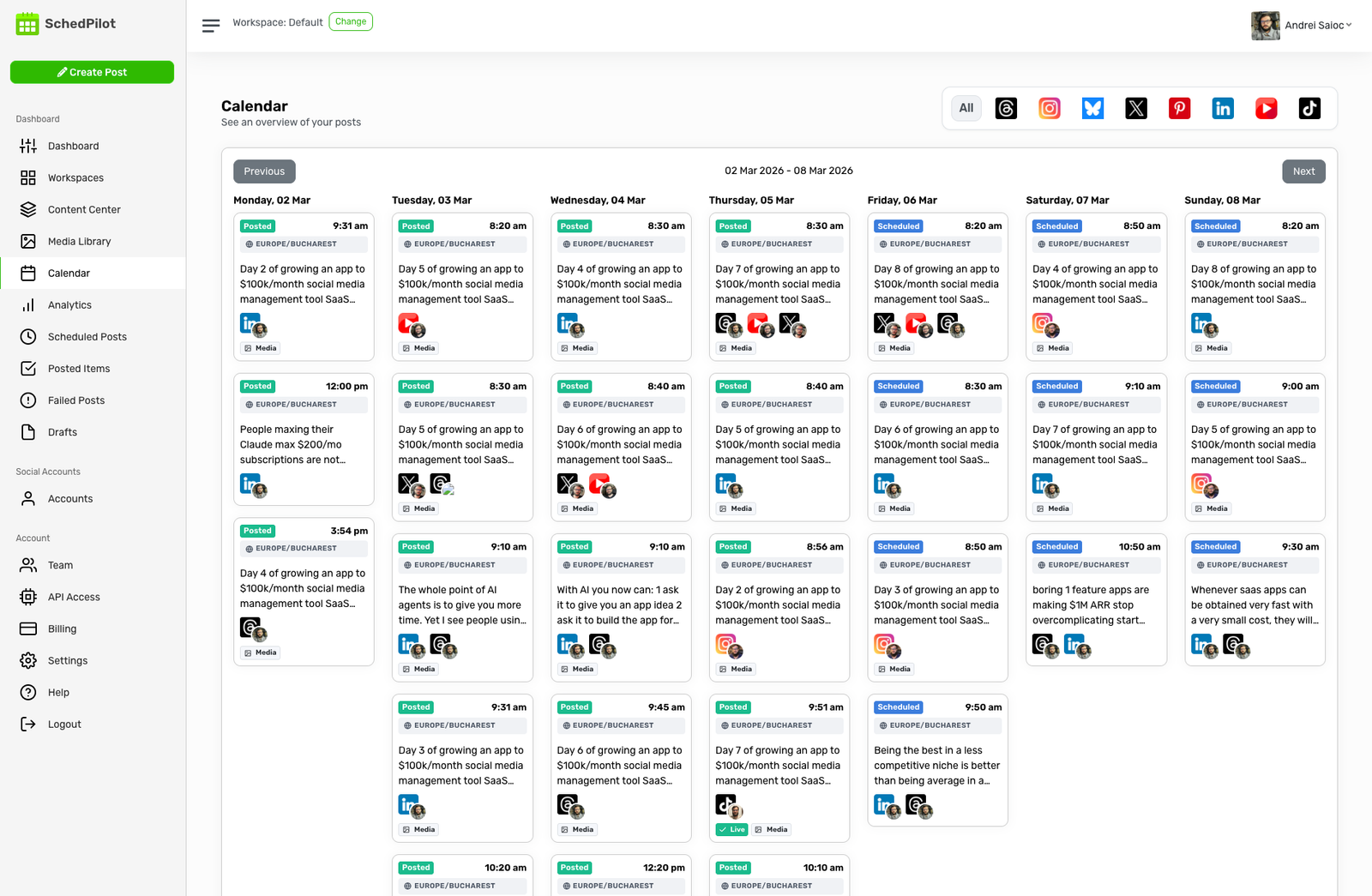
If you’re creating, captioning and publishing each post on the day it goes out, Instagram eats an hour a day and the engagement routine is the first thing you drop. Batch the production, schedule the publishing, and that daily hour shrinks to twenty minutes of talking to people. Which was the growth lever all along.
A week that works for a solo creator or a small business looks like this:
| Day | Post | What it’s for |
|---|---|---|
| Monday | Reel (15–40 sec, one tip or one idea) | Non-follower reach |
| Tuesday | Stories only | Keeping existing followers warm |
| Wednesday | Carousel (teach one thing, 6–10 slides) | Saves and sends |
| Thursday | Stories only | Polls, questions, behind the scenes |
| Friday | Reel | Non-follower reach |
| Saturday | Photo or carousel, more personal | Follow-rate (people follow people) |
| Sunday | Nothing, or a collab post when you have one | Borrowed audience |
That’s four feed posts a week: two Reels, one carousel, and one personal post. Sixteen a month. It’s a realistic amount to produce in two batch sessions.
Free trial · No upfront payment · 10+ platforms
Try SchedPilot for free
Post on 10 platforms at once. Great for influencers, marketers, agencies.
The monthly workflow
Block one afternoon every two weeks. In the first hour, plan eight posts against the table above. Spend the next two filming and designing everything in one go, since you’re already set up and lit, and one outfit change makes it look like two different days. Use the last hour for captions, keywords, and your five hashtags per post.
Then load all eight into a scheduler and pick the times. In Schedpilot’s Instagram scheduler you drag posts onto a calendar, so you can see at a glance whether you’ve stacked three Reels in a row or left a five-day hole. Reels, carousels and single images all publish automatically (the Reels scheduling walkthrough covers the details), and if you’re loading a whole month at once, bulk scheduling from a CSV is faster than doing it post by post.
For timing, don’t trust a generic “Tuesday at 11 a.m.” infographic. Your audience’s active hours are in your own Insights, and the best time to post calculator will give you a sensible starting point by timezone and niche. Then look at your own results after a month and adjust.
Before you lock the month in, preview the grid. Most visitors make their follow decision while looking at your top nine or twelve posts as a block, and a grid planner shows you that view before anything is live. You’re checking for variety and for a consistent look. It doesn’t need to be a perfect checkerboard, and nobody has cared about those since 2018.
Instagram’s own app can schedule posts too, up to 75 days ahead for professional accounts, and it’s fine if Instagram is your only platform and you don’t mind doing it on your phone. The reasons to use a separate tool are a real calendar view, desktop uploads, and sending the same Reel to TikTok, YouTube Shorts and Threads in one pass. We compared the no-cost options in what’s actually free among Instagram schedulers, and if you’re unsure whether you need a scheduler or just a planning doc, this comparison settles it.
The daily twenty minutes
With publishing handled, your daily Instagram time has two jobs. For the first ten minutes after a scheduled post goes live, reply to every comment, because early conversation helps the post and makes commenters more likely to come back. Then spend ten minutes on the outbound routine from the previous section.
Does scheduling hurt reach? No. Instagram’s ranking doesn’t know or care whether you pressed Share with your thumb or an approved API did it for you. What hurts reach is a post that goes up and sits in silence, and that’s a behavior problem you can fix by putting a reminder on your phone for publish time.
What to expect in the first 90 days
This is my own rough benchmark rather than a published statistic: for an account under 5,000 followers, doing the above consistently, 6 to 10% a month is good and anything above that means a post broke out. Month one is usually the weakest, because you’re still learning what your audience sends and saves.
Track the number weekly rather than hourly. A follower tracker gives you the trend line and shows unfollows, which matter as much as follows. Losing a few followers after every post is normal churn. Losing a lot after one specific post tells you something about that post. If you’re curious how your engagement rate stacks up for your industry, the 2026 benchmarks compare five data sources.
At day 30, open Insights and sort posts by follows generated. It’s a different ranking from likes, and it’s the one that matters. Whatever’s at the top, make three more of it next month and drop whatever’s at the bottom. After three cycles of that, your calendar is built on evidence from your own account, and you can stop reading articles like this one.
Free trial · No upfront payment · 10+ platforms
Try SchedPilot for free
Post on 10 platforms at once. Great for influencers, marketers, agencies.
Frequently asked questions
What is the best time to post on Instagram?
The honest answer is when your own followers are online, which you can see in Insights under Total Followers, then Most Active Times. Broad studies tend to land on weekday mornings and early evenings in the audience’s local time, but the variation between niches is large. Pick a time from your own data, keep it for a month, then test one alternative.
How can I get real Instagram followers fast?
The fastest legitimate routes are collab posts with accounts slightly bigger than yours, and Reels built to be shared by DM. One collab can do in a day what solo posting does in a month. “Fast” is relative, though. Anything that promises thousands of real followers in a week is selling bots.
Should you buy Instagram followers?
No. Bought followers don’t watch, like, or send your posts, so your engagement per follower collapses, and that ratio is a big part of what decides whether Instagram shows your content to anyone new. You pay money to reduce your reach. Brands checking your account before a partnership can also spot it in about a minute.
Can you schedule posts on Instagram, and does it affect reach?
Yes on the first, no on the second. Professional accounts can schedule inside the Instagram app up to 75 days out, and third-party schedulers publish through Instagram’s official API. Neither carries a reach penalty. The advantage of scheduling is that your time goes to replying and engaging when the post is live instead of fighting with the upload screen.
How often should you post on Instagram to grow?
Three to five feed posts a week is a good range for most small accounts, plus Stories on most days. Frequency matters less than not disappearing. An account that posts four times a week for six months will outgrow one that posts daily for three weeks and then goes quiet.
How do collab posts work on Instagram?
When creating a post or Reel, tap Tag People, then Invite Collaborator, and search for the other account. Once they accept, the post shows on both profiles with both names in the header, and likes, comments and views are shared. The account has to be public for the invite to work.
How many followers do you need on Instagram to get paid?
There’s no single number. Brand deals happen at any size, and accounts with 2,000 to 10,000 engaged followers in a specific niche regularly land paid or gifted partnerships, because brands care about engagement and fit more than raw count. Instagram’s own monetization features, like subscriptions, have their own follower thresholds, and those change fairly often, so check the professional dashboard for what your account currently qualifies for.
How many followers do you need to go live on Instagram?
Since a policy change in 2025, Instagram requires a public account with at least 1,000 followers to start a Live. Smaller accounts can still use video calls and Stories for real-time content. It’s one more reason the first thousand matters.
How long does it take to grow on Instagram organically?
Going from near zero to 1,000 engaged followers typically takes three to nine months of consistent posting for an account without an existing audience elsewhere. It goes faster if you have an email list, a shop, or another platform to bring people over from, and slower if you post irregularly. If you’re eight weeks in with a steady 6 to 10% a month, it’s working. Keep going.
Free trial · No upfront payment · 10+ platforms
Try SchedPilot for free
Post on 10 platforms at once. Great for influencers, marketers, agencies.
Related posts
How to Roll Out a Rebrand on Social Media Without Losing Your Handle, Your Followers, or Your Weekend
September 20, 2026
Quand poster sur Instagram en 2026 : les meilleures heures, jour par jour, à l’heure française
September 18, 2026
Mejor hora para publicar en Instagram en 2026, por día, formato y país
September 18, 2026
6 Best Threads Schedulers in 2026, Ranked by What You Actually Pay Per Post
September 17, 2026